Showing posts with label Monkey reads. Show all posts

Tuesday, January 14, 2014

Peering Into the Dark: Lovecraft’s Great Depression

Once again, we gave TMI custodian Kris Kendall the assignment the rest of us were too lazy to tackle: Read a collection of H.P. Lovecraft stories. Lovecraft's reputation makes for a daunting task, but in a surprise only slightly bigger than our realization that Kendall can read and write, the smelly bastard actually had something to say.


Read the weird fiction of H. P. Lovecraft during the dreary month of January.

The stories by the “godfather of modern horror” echo the long, dark, cold and soggy stretch of the first month of the year, when the carnival of the holiday season has left town. Bleakness rules all in January, and it’s the defining tone of Lovecraft’s work.

Tales of H.P. Lovecraft, selected and edited by Joyce Carol Oates, comes highly recommended and there’s good reason for that.

Her curation of the shorts and novellas builds logically, beginning with the “The Outsider” – a sort of character study that has been imitated so many times, it nearly suffers from its own influence.

Which isn’t to say it’s a bad story – on the contrary, Lovecraft builds to his big (obvious to modern readers) reveal skillfully, like a waltz for the doomed that ends in ugly, minor chords meant to shock and horrify.

Then the real recurring themes of what people think of as “Lovecraftian” begins with “The Music of Erich Zann” and “Rats in the Walls.”

The former introduces the idea that there are other worlds, other dimensions, near our own and that the barrier between them is thin, perhaps easily breached. While the latter introduces a theme that Lovecraft returns to in subsequent works: family lineage.

He writes of ancestry that reaches so far back in time that our brains can scarcely grasp the distance. And in that distance are ugly behaviors, ugly genetics, that ripple forward into the modern world.

“The Shunned House” – at least in the Oates collection – acts as a sort of rest stop before the big, well-known stories begin. And we’d argue that it’s a lesser tale, but it left too much of an impression. However, “Shunned” illuminates the major problem with Lovecraft: he rambles and repeats himself.

Like Charles Dickens and, to a lesser degree, Lovecraft's predecessor in horror, Edgar Allan Poe, Lovecraft writes as if he were paid by the word. He was. “Shunned” exposes the Lovecraft novice to the author’s tendency toward unnecessary length in pursuit of a bigger paycheck.

Lovecraft’s garrulous narrative is absent entirely from “The Call of Cthulhu.” The story was published in 1926, four years before Lovecraft would begin corresponding with fellow Weird Tales contributor Robert E. Howard. But it’s reasonable to aver that Lovecraft was reading Howard’s work by then. Perhaps Howard’s electric, two-fisted prose influenced the efficiency of “Cthulhu.”

Structured like the classic Victorian horror tales, “Cthulhu” begins with the declaration that it was “found among the papers of the late Frances Wayland Thurston, of Boston.” The opening paragraph stands as one of the best passages in this collection, a concise portent of what is to come, but also a clever assessment of why humankind seems incapable of advancing very far before collapsing.

Part murder mystery and part action yarn, “Cthulhu” introduces everything that would come be known as what Lovecraft associate and superfan, August Derleth, called “ the Cthulhu Mythos.”  There are ancient cults worshiping a beast straight out of Revelations, global conspiracies in place to deny the existence of those cults, and geometry so otherworldly, that human senses can’t properly perceive it.

Ringing, siren-like, above it all is the nightmare realization that beings from across the galaxy, and often from worlds outside our own universe, have been to Earth – some of them are still here, waiting for the right conditions to rise up again and snuff us out like spent matches.

Lovecraft revisits that idea repeatedly with “The Dunwich Horror,” “At the Mountains of Madness,” and “The Shadow Out of Time.” In doing so, he expands his rogues gallery, subtly but methodically linking his beasts by showing how they fit together into a history pre-dating, and later concomitant to, our own journey out of the cave and into the false security of civilization.

But for all the monsters and mythology, an equal amount of the dread that permeates Lovecraft’s writing comes from his doomed heroes. In fact, his protagonists rarely qualify as heroes, as many of them end up dead, or mad, and always along the way, fall headlong into the deep isolation that comes with the knowledge they acquire.

Inside joke!
Without having read a proper biography of Lovecraft, it’s pure speculation that the man was probably depressed through most of his life. At the very least he was deeply cynical about the world – for he outright states multiple times that humans are not nearly so advanced or evolved as we like to think. If we don’t destroy ourselves first, there are plenty of outside forces just waiting for an opportunity to do the job for us.

He illustrates that anxiety well in “The Colour Out of Space.” The story concerns a New England farmer, in the rural hills west of Arkham, a stand-in for Salem, Massachusetts. A meteorite lands in the fields of the farm and poisons everything it touches, including the minds of the farmer and his family.

In pure book report terms: The corrosive power of a cosmic force could easily stand in for events in our mundane lives that are sometimes unbearable, and like the dying, mad farmer of “The Colour ...” those things can destroy us. But for some reason, or lack of reason, we are drawn to the destructive agents.

Lovecraft himself had what is described as a “nervous breakdown” before he graduated high school. Both his father and mother had similar events and both died within a few years of those breakdowns, though neither died as a direct result of the breakdown.

Knowing that fact makes the reading of “The Shadow Over Innsmouth” a more potent experience. The story of an isolated fishing village in Massachusetts probably best embodies Lovecraft’s pet idea of family history and biology working in tandem to cast our fates in stone. None of us has progressed far past our ancestors.

But let’s leave the analysis for greater minds because “Innsmouth” is a ripping good tale. It’s the kind of creepshow dread that The X-Files did so well. An educated city dweller ventures into the rural unknown, where his status as an outsider is immediately recognized and used against him.

The last third of the story has more of that “Call of Cthulhu” action – an escape scene that takes up an entire night, where the simple task of leaving becomes nearly impossible.

And that brings us back to the beginning. No matter what T.S. Eliot says, January is the cruelest month. The nights are long, the days are dark. Cold and wet rule the forecast. February is January’s petulant little sister, so don’t worry if your journey into H.P. Lovecraft’s writing spills over into the weeks of Valentines and alleged whispers of spring. The terror is there to keep you company.

Friday, October 5, 2012

The Monkey Reads: Roald Knows How to Pick 'Em

Roald Dahl’s Book of Ghost Stories
Various; Introduction by Roald Dahl
(Macmillan)
To curate this collection of haunted tales, Dahl read more than 700 short stories, which he admits with a wry “so you don’t have to” attitude in his superb introduction. Note, these are not stories written by Dahl, but rather stories he found to be of high quality and wanted to share.
 
His original intent was to adapt these stories for an American television program – an anthology show in the vein of The Twilight Zone and The Alfred Hitchcock Hour. But after a pilot was produced, the show was nixed and Dahl was left with a stack of stories to share.

The best entry in Ghost Stories is Robert Aikman’s “Ringing the Changes.” This tale of a newlywed couple on their honeymoon in a quiet, nearly abandoned seaside village in England has its own strange rhythm that rewards greatly with sheer creativity as it builds a genuine sense of dread at what’s coming.

Edith Wharton and Cynthia Asquith contribute a story each, with Wharton’s “Afterward” burying the scares under an affecting sense of loss, confusion and grief, as a woman attempts to figure out what happened to her missing husband. Asquith’s “In the Corner Shop” has such descriptive prose that it works even though you know where she’s headed after a page or two.

Jaded, over-stimulated modern brains will recognize the plots of some of these stories, as they’ve been repurposed many times, and, as with “On the Brighton Road” by Richard Middleton, read like urban legends.

But that doesn’t mean we can’t still take pleasure in high quality writing of A.M. Burrage’s “Playmates” or F. Marion Crawford’s “The Upper Berth.”

Reference material: Own a copy of The Oxford Book of Victorian Ghost Stories? You may have already read some of these, but can likely find something new. And anyone who will stay up late to watch a favorite episode of The Twilight Zone should enjoy Dahl’s collection.

Monday, September 5, 2011

The Monkey Reads: Puritanical Ass-Kickery

The Savage Tales of Solomon Kane
By Robert E. Howard
(Del Rey)
Howard’s kinetic prose elevates the adventures of his “Puritan swordsman” Solomon Kane beyond what a reader should reasonably expect from early 20th century vintage supernatural/action pulp.

Kane doesn’t emerge from his trials a winner, and in fact seems more doomed by his own thoughts than by any of the beasts, schemes or weapons that threaten him throughout the collection. The hero defeats his enemies, but he doesn’t win.

Yes, Kane is essentially undefeated in hand-to-hand combat and villains across the oceans know he’s a badass without equal – the kind of man who would travel from the safe confines of Devonshire to the pirate harbors of the Mediterranean and finally deep into the jungles, plains and mountains of central Africa just to find the kidnapped daughter of a family friend, as Kane does in “Moon of Skulls.”

But the more actively Solomon Kane pursues some unknowable, unreachable destiny, the less attainable it becomes. Unlike many action heroes, who are found by fate and reach greatness as they struggle to claim their rightful place at the top, Kane chases a calling he can’t really answer or satisfy.

Howard’s tales of the curious but introspective adventurer trace the journey of a man who is losing his faith.

The writer even acknowledges in the narrative that Solomon Kane wears the drab Puritan garb only out of habit. By the time Kane finally returns to Devonshire [“Solomon Kane’s Homecoming” one of the tales told in verse], his clothes are ragged, he wears a bright green sash and carries a tribal staff, accoutrements more befitting a pre-Christian shaman than an austere Protestant.

As Kane loosens his grip on his white, Christian (ahem, colonial) perspective on the world, he gains humanitarian enlightenment and accepts that the world is a weird, wonderful and sometimes terrifying place.

Though Solomon Kane exists in a 16th century land of Western expansion, he could stand in for the 20th century academic or expatriate who has seen the world and has begun to question his Western European place in it.

Above all this subtext philosophy rages crackling action and fantasy writing, some of the best of the genre. Kane travels Europe, Africa and briefly lands in the New World, clashing, colliding and cooperating with supernatural beings and profane men who live and die by the blade.

Howard balances compact writing with descriptive flair to make fight sequences and fast-paced action pop with four-color contrast against detailed observances of these alien worlds. As with his horror writing, Howard makes the unreal seem plausible, such as when Kane’s unlikely ally, an aged African shaman called N’Longa, reanimates a corpse to terrify a tribe under the sway of an old enemy of Kane. [“Red Shadows”]

A repeated warning for the casual reader: Like Edgar Rice Burroughs, H.P. Lovecraft and other fantasy writers of their era, Howard’s work does include language and “truths” about ethnicity that are simply wrong.

Oddly enough, Kane (and perhaps Howard) changes so much through the course of this short story collection, that the hero not only acts as a challenge to the “rightness” of colonialism, but may also be a barometer of changing attitudes in the early 20th century.

Howard lived and wrote in Texas and witnessed his share of ethnic and class injustice. And Solomon Kane is nothing if not a man out of step with his time, finding himself closer aligned with both the ways of a distant past and a possible future his countrymen simply haven’t caught up with.

Reference material: Fans of Dashiel Hammet's Red Harvest might be pleasantly surprised by Howard's similarly gruesome, testosterone-filled pulp. If Sergio Leone's Westerns own some space in your cinematic library, Clint Eastwood's pancho-wearing (anti-)hero bears more than a passing resemblance to Solomon Kane, though Kane doesn't share his carnal appetites. And if you read comics, mom will be delighted to see you reading a "real" book. She doesn't have to know the truth.

Saturday, May 14, 2011

Grim Lands, Great Tales

Writer and editor Howard Andrew Jones wrote a piece for NPR on three collections of pulp fantasy writing worth your time. Naturally, he calls out Robert E. Howard.

Jones also reminds The Typing Monkey that we've been meaning to read some Leigh Brackett and introduced us to the work of Manly Wade Wellman. That's right, an action/sci-fi/fantasy writer named Manly.

In a bit of serendipity, the day before we stumbled across Jones' recommendations, we heard super-librarian and astute critic Nancy Pearl discussing genre fiction. We'll paraphrase her wise words here: It's a shame that literature is judged by its best work while genre fiction is judged by its worst.

True. True.

That reminded us that we owe you a review of The Savage Tales of Solomon Kane. We read it in spring so that you might read it during the summer.

Wednesday, February 23, 2011

The Monkey Reads: Miss Israel Regrets (Maybe)

Can You Ever Forgive Me?
Memoirs of a Literary Forger
By Lee Israel
(Simon & Schuster)
The snakes-and-ladders path from obscurity to stardom to poverty rarely surprises. We know the story arc well yet still tune in. A once-celebrated biographer, Lee Israel bucked expectations by skipping the drugs and rehab nonsense – really what’s interesting about that? Instead, she opted for something daring and far more fun: forgery.


In Forgive Me, Israel carefully lays out how she ends up tossing multiple typewriters into dumpsters around Manhattan, the FBI hot on her trail. It reads like a true-crime confessional because it is.

Early success with biographies of Tallulah Bankhead and Dorothy Kilgallen led to spending advances before Israel could produce the work. She lived beyond her means, and produced a biography of Estee Lauder that bombed with both reviewers and retailers. From there it was short ride to finding out she hated “real work”; then welfare and a sick cat pushes Israel to make some poor choices.

Israel’s bad judgment makes for some compelling reading. She’s a classic anti-hero who admits to being over-confident, elitist and coarse to many people to whom she should have been kind, even if she’d had to fake it.

One thing she didn’t fake was her first celebrity letter. Israel simply stole three Fanny Brice letters and sold them to a collector.

When asked if she had any others, the reader can practically hear the lightbulb spark to life above Israel’s head and she sets to work on imitation Dorothy Parker, Noel Coward and others. Her Parker letters are a delight to fans of that writer, perhaps because they both drank too much and pissed off friends.

Israel’s outlaw charm makes Forgive Me sing. She can’t believe she’s getting away with it any more than her audience can but neither can she stop herself. The con is too delicious and too profitable. Root for Lee Israel all the way to the end because, unlike bloated rockstars who do the drugs-and-rehab routine and end up recording flaccid comeback music, her post-reform output is outstanding.

Friday, October 16, 2009

The Monkey Reads: Mr. Gorey Presents

The Haunted Looking Glass: Ghost Stories Chosen by Edward Gorey
Various Authors
(New York Review Books Classics)
Even if the reader has previously encountered some of these 12 supernatural tales, the collection is well worth a look. The late Edward Gorey -- an illustrator, writer and critic with a gift for the comically macabre -- selected well when he assembled this line-up of short stories.

Most of the stories come from the Victorian era, a boom time for horror writing in England and the United States, as the Industrial Age was steamrolling magic and wonder out of day-to-day existence. Consequently, a good number of the authors pit logic and reason against events that defy any sort of explanation or scientific confinement -- a horror fiction trope that still has plenty of tread left on it.

Gorey's good choices include some literary giants. Robert Louis Stevenson and Bram Stoker offer, respectively, "The Body-Snatcher" and "The Judge's House." And Charles Dickens surprises everyone with his perfectly readable and uncharacteristically efficient "The Signalman."

But it's the lesser-known writers, some of them icons to fans of Victorian horror, that deliver some of the best scares in Looking Glass. Algernon Blackwood's "The Empty House" is the rare haunted house yarn that hits all the expected notes without feeling clichéd.

L.P. Hartley's "A Visitor from Down Under" uses flashbacks and meticulous pacing to set up a genuinely creepy tale of revenge from beyond the grave. And W.W. Jacobs' frequently imitated and referenced "The Monkey's Paw" should compel the reader to seek out more of his bleak but comical work.

And if you've seen the excellent Jacques Tourneur film Night of the Demon, then you're already familiar with the story it's based on, "Casting the Runes" by M.R. James. The film is good, the story is excellent and closes this collection on the highest note possible. Can a torn up piece of parchment terrify? Yes. Yes it can.

Reference material: If 100-year-old horror writing is new to you, there's no better place to start than The Haunted Looking Glass. J. Sheridan LeFanu isn't included here, but the Irish writer is a pre-Victorian horror superstar and worth your attention. And Dover Thrift Editions offer numerous cheap collections of classic horror writing.

Friday, July 24, 2009

The Monkey Reads: On Death

The Year of Magical Thinking
By Joan Didion
(Vintage)
Leave it to Didion's short, sharp new-journalism-defining style to examine the grieving process with both a microscope and telescope. As with her other non-fiction writing, Didion inserts herself into the equation carefully and well, a feat often imitated but rarely duplicated or perfected by generations of others who've attempted reporter-as-the-story writing.

Discussing her life and her emotions is essential for a book about the death of her husband of 40 years, John Gregory Dunne. But her research and explanations of the cause of death, and how hospitals and other medical staff in the United States deal with death, pulls back just far enough to let the writing function as an examination of our attitudes toward death all while reminding the reader of the very real event that triggered Didion's words.

Identified early on by hospital staff as a "cool customer" because she didn't instantly sob and rend her clothing at the news of her husband's death, Didion immediately -- perhaps uncontrollably -- goes into reporter mode and learns what being a "cool customer" means, even as the layers of her grief peel away. With each layer comes a new discovery about mourning, what we allow ourselves to do and show when everyone around us knows of our personal tragedy.

For all the sadness (her daughter Quintana is fatally ill throughout the course of the book) Didion squeezes some humor out of the story. An attempt to take up crossword puzzles reveals how distracted she is. Later when she reports to a friend that she and her daughter split a Big Mac during a cross-country flight with two medics, Didion's daughter is conscious enough to correct her. It was a Quarter Pounder they ate.

Magical Thinking paints a tender picture of lasting love. For the reader it's a brave exposure of what goes on in the mind of a person who is just beginning to discover and navigate the empty spaces in a life no longer shared.

Reference material: Mary Roach's Stiff is a fascinating book about what happens to cadavers before and after the funeral -- a good read for the clinically minded. But William James' The Varieties of Religious Experience is a better companion to The Year of Magical Thinking. Both touch on the universal and the personal for events that are assured for all of us, and always intertwined.

Wednesday, June 24, 2009

The Monkey Reads: Pirates, Vikings & Ancient Magic

The Black Stranger and Other American Tales
By Robert E. Howard
Introduction/Edited by Steven Tompkins
(Bison)
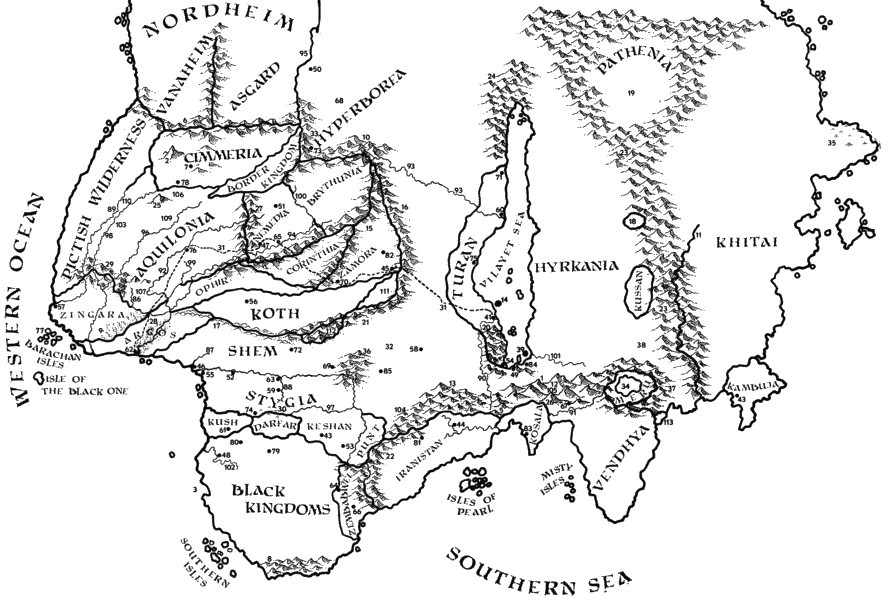
The title story opens this collection with a magnificently tangled plot involving pirates and buccaneers racing to claim a cursed stash of treasure secreted away on the shores of the Pictish Wilderness*, where a nobleman lives in self-exile, on the run from the titular stranger, to whom he owes more than he can repay.

Howard lays out details at just the right points to give all the major players enough back story and motivation to keep the pulp-hungry reader chewing at the pages until the moment Conan re-enters the plot. Yes, the character better known by his usual job title "the Barbarian" has adapted to changing times, trading a fur loincloth for Errol Flynn finery in order to conquer the pirate racket. Howard's best-known creation behaves as both deus ex machina and secret star of "The Black Stranger." And he's still an ass-kicking good time.

After the mini-epic start, the subsequent Viking and conquistador-era tales slow the momentum until the next pirate yarn, "Black Vulmea's Vengance," quickens the pace again. Both "Stranger" and "Vulmea" could easily translate into films, though the former would have to get audiences past the idea of Conan outside of his expected sword-and-sandals milieu.

The final third of this set lives up the American Tales promise by wading waist-deep into late 19th and early 20th century Southern-gothic grime. Pitting white Christian men against all the ancient magic the New World, and its bounty of imported faiths, can dredge up.

Readers sharp enough to cope with the period-referential language will be rewarded with Howard's urban legend-like "Kelly the Conjure-Man" which acts as a sort of prologue for "Black Canaan" and its humid tale of a voodoo-fueled slave uprising in the swampy outskirts of a small farm village.

Howard deftly uses the Victorian horror structure ("Pigeons from Hell" and "The Horror from the Mound") in territory more familiar to him, and allows for a reverential take on American Indian spiritualism in "Old Garfield's Heart."

Anyone with a moderate level of curiosity about Howard's writing might as well start here. There are enough violent thrills to inspire a return to the world of Conan and to Howard's horror tales.

Reference material: If you read Conan or Kull comics as a kid, reading the texts from which those bloody panels were derived makes for a joyfully adolescent summer read. Also EC Comics fans and readers of early Stephen King will dig Howard's words.

*In the first published draft of this review, The Typing Monkey incorrectly identified the location of the events in the title story as a "not quite colonial American coast" presuming that Howard's vague references to Pict tribes was his way of defining Native Americans in terms that Europeans might have. Not so. The Picts, a real life warrior clan in pre-Roman invasion Scotland, are incorporated into Howard's Hyborian Age, the fictional age he created for the Conan stories, so that his hero might interact with a variety of historical types that weren't necessarily concomitant. We regret the error.

Friday, March 13, 2009

The Monkey Reads: Pow! Wham! Ka-BOOM!

Who Can Save Us Now? -- Brand New Superheroes and Their Amazing (Short) Stories
Edited by Owen King and John McNally
Illustrations by Chris Burnham
(Free Press)
The minor boom in superhero lit over the past couple years -- Soon I Will Be Invincible, Superpowers, et al. -- rolls along. This collection of shorts may be the ideal format for prose about characters generally more comfortable in the full-color panels of a comic book.

Will Clarkes' "The Pentacostal Home for Flying Children" and Scott Snyder's "The Thirteenth Egg" leave the biggest impression. Both stories have the stacked, portentous pacing necessary to allow the reader to completely suspend disbelief so far that every supernatural element, including a pack of flying juvenile delinquents and a living atom bomb, becomes thoroughly believable.

Elizabeth Crane's tale of a boy fixated on a real-life hero disappoints by doing little with a promising idea. And there's a batch of puzzling entries in the section called "A Shadowy Figure." The mercifully short "In Cretaceous Seas" is bitter for no apparent reason and despite being a good character sketch "Roe #5" never lifts off beyond cheap Twilight Zone tricks. "The Snipper" plays cute so much that the weighty moments stick out awkwardly.

The last two sections, "Behind the Mask" and "Super Ordinary" deliver the most consistent quality story-for-story. The authors of those shorts dig into the sticky normal things that happen to all of us, letting the superhuman abilities be the life-complicating annoyances they actually would be in reality.

Reference material: There's plenty of goodness in Who Will Save Us Now? to merit a recommendation. Reliable sources also suggest Soon I Will Be Invincible and Superfolks, which apparently did all of this a few years before the most recent attempts at meta-lit about men in capes and tights.

Friday, February 6, 2009

The Monkey Reads: It's Hard to Believe It

Charles Fort: The Man Who Invented the Supernatural
By Jim Steinmeyer
(Tarcher)
Writer Charles Hoy Fort's life, at a glance, follows a Victorian literature arc.

After a privileged but suffocating childhood and a stint as a cub reporter at a farm-league newspaper, he traveled for a short time as a hobo (albeit a vagabond with a secret property income), married below his station and struggled with poverty as he tried his hand at fiction, before finding his calling as an eccentric philosopher who may or may not have believed what he wrote.

Biographer Jim Steinmeyer clearly admires Fort's mercurial goals and Puckish stance of challenging both science and religion. As a result Fort can feel like a love letter. But it's easy to get caught up in Steinmeyer's appreciation and elevate Fort to a status he may not have deserved -- and based on this biography, didn't necessarily want.

Fort collected the odd stories from the back pages of small town papers, almanacs and published journals. The clips he sought were accounts of what today's audience would call unexplained phenomena, supernatural occurrences and mysterious sightings.

What made Fort's efforts noteworthy was his methodical yet playful analysis of the data. Fort shot down scientific explanations of a well-documented rain of frogs for being too sloppy. Alternately, Fort neither rejected nor embraced a divine machine behind such events.

So what's left? Fort's outsider ideas that are ultimately no stranger or less plausible than anything religion or science has to offer -- reorganizations of the cosmos and science-fiction sounding ideas on worlds above, below and concomitant to the one we know.

Steinmeyer avoids getting too bogged down in the tangle of Fortean philosophy -- a smart move that allows him to pull back far enough to show how Fort's writing inspired both outrage, scoffs and, worst of all, disregard.

The wider scope also gives an affectionate look at Fort's positively mundane, comfortable life once he settled in with his wife Helen. The man who discussed UFOs a good 20 years before the rest of the country paid attention spent his days in the library and his nights with his wife drinking beer, eating snacks and going to the movies.

Fort's contemporaries included ally/true believer Theodore Dreiser; harsh critics H.L. Mencken and H.G. Wells; and a few, such as Ben Hecht, who thought of the man as a crackpot savvy enough to laugh at his own cosmic jests.

Based on Steinmeyer's take, Hecht may have been closest to the truth.

Friday, December 12, 2008

"Useless Insignificant Poetic"

HOLLYWOOD'S HELLFIRE CLUB
The Misadventures of John Barrymore, W.C. Fields, Errol Flynn and "The Bundy Drive Boys"
By Gregory William Mank with Charles Heard & Bill Nelson
(Feral House)
The Bundy Drive Boys drank like they meant it. And no matter how bohemian, heroic or tragic any of us have ever felt, chances are one of The Boys proved himself to be more so.

The true star of this biography is the painter John Decker. A master imitator of the great masters, he had no qualms about selling forgeries to clueless celebrities who'd suddenly decided to invest their movie money in fine art. The story of how Decker got to California deserves its own book.

And Mank makes a convincing case that Decker, not Barrymore or Fields, was the leader of The Bundy Drive Boys -- a collection of movie and media stars who found comfort and encouragement in one another's company.

They shared a love of booze, women and bawdy humor, and their meetings consisted primarily of staying up until the dawn, reciting Shakespeare and filthy jokes at Decker's Bundy Drive residence in Los Angeles.

Other Bundy Boys included newsmen-turned-screenwriters Gene Fowler and Ben Hecht as well as junior members John Carradine, Errol Flynn and Anthony Quinn. A fringe member, Sadakichi Hartmann -- equal parts crank, poser and earnestly misguided artist -- behaves almost as a subplot in the book.

Through their stories, first told in rapid, short chapters detailing the adolescence and early adulthood of each member, Mank and his co-authors not only render a vivid picture of the film industry in its infancy, but paint a sordid mural of the now rote narrative arc of American celebrity.

Hollywood's Hellfire Club reminds the reader that these are the magnificent first-generation stars of the talkies, an essential move to earn our sympathies. But it still stings when the text reveals the mania that fueled their creativity -- the women they loved and tormented (and who loved and tormented them); and the excess of vice allowed by too much money and too few boundaries.

Thursday, November 20, 2008

Distraction of the Innocents

Nobody on The Typing Monkey staff keeps up with the world of comic books. There are simply too many titles on the shelves these days. When we finally got our hands on the complete Black Hole series by Charles Burns last year, The Typing Monkey realized how far things have come since that issue of The New Mutants where Nightcrawler helps Cannonball learn how to use his powers.

Now then, they'll put anything on the internets these days and some of it is actually worth looking at. While in the midst of online research recently, we discovered several comic books available for free on the Web. All the titles are of the action/superhero/sci-fi variety and are designed to lure readers into buying the actual physical product. Still, you can't beat free comics online, and there are worse ways to squander time.

Some of these titles have been around for a few years, but we already addressed that in the opening paragraph. So don't e-mail us with sarcastic indignations about how out of touch we are.

Maintenance
(Oni Press)
This absurd title depicts the mundane tasks performed by two janitors who work for a company that supplies weapons of mass destruction to super villains. The black and white art meets the cartoonish concept at its level, and the dialogue and humor pack a fair snap.

Night & Fog
(Studio 407)
An aborted military experiment strands a few humans on an island where the locals are not terribly friendly. The online teaser packs much into 10 pages. That's still too short, but the hazy coloring classes up the affair.

Proximity Effect
(Top Cow/Spacedog)
Superheroes whose powers only work when they're within 30 feet of each other -- both Marvel and DC comics have danced around that concept, but neither exploited it as well as Proximity does. The plotting doesn't go beyond standard X-Files conspiracy territory, but this is worth further reading.

***

Sibling duo Jonathan and Joshua Luna have worked on other writers' and artists' books, but really shine with their own collaborative titles. The first issue of each series they've created is free online at the Lunas' site:

Ultra
(Image)
With all the meta superhero stuff out there, Ultra can seem common at first glance. But the Lunas are a lot like Joss Whedon, in that they actually have the ability to write believable female leads in a pulp genre not known for such feats. So do give it a look, and remember it debuted in 2004.

Girls
(Image)
Girls is just plain great -- the ideal first-issue structure. With just enough back-story, mystery and sci-fi weirdness, it hooks the reader immediately, the way sci-fi subtext disguised as serialized fluff should.

The Sword
(Image)
While not a comic-book adaptation of the occult adventures of the '70s metal revivalists from Austin, The Sword is in fact another great potboiler. In it, a parapalegic woman learns the hard way that her family may have deep connections to the titular weapon -- a mystical blade with strange properties.


If these introductions don't yank your eyeballs to the remaining issues of the Lunas' work, then we can't help you.

Honorable mention:

Last Blood
A group of vampires must protect the last remaining humans on earth from a zombie horde. The vampires are not acting altruistically -- they need a fresh blood supply. This online comic is intended as public storyboards for a planned film. We encourage readers to ignore scripter Bobby Crosby's work-in-progress comments on each page, which hamper the flow of the story. Just enjoy the stoner/gore-fan concept and the artfully rough sketch-art by Owen Geini.

Links to the non-Luna titles were culled from Den of Geek's mind-numbing list of 75(!) comic book titles that are currently in line for cinematic adaptations. (Good luck, Hollywood.) And the AV Club interviewed the Luna Bros. this past summer.

Wednesday, August 27, 2008

The Monkey Reads: Classic Rock Radio Murders

Radio Activity
By Bill Fitzhugh
(HarperTorch)
Summer reads don't get much better (or quick) than this paperback potboiler. Radio Activity comes on like tasty junk food disguised as a reasonable meal -- just like a picnic.

Rick Shannon is a radio disc jockey who discovers that the once-legendary on-air personality he's replacing at a small Mississippi classic-rock station may've been murdered. Amateur sleuthing ensues and in the process the author laments the diluting of American identity.

Fitzhugh lovingly defines true classic rock over the course of the novel, via Rick Shannon's unexpected, if unlikely, opportunity to recast the playlist at a second-tier market station.

Thinking people everywhere share the main character's (and Fitzhugh's) anger at corporate radio's pathetic limitations for every genre. So even those unfamiliar with the deep AOR trivia in Activity can delight in Fitzhugh's fantasy of music geeks reprogramming the airwaves.

The radio biz trivia doesn't fight too much with the mystery/noir elements of the story, though dedicated Agatha Christie types would probably fidget. And some Fitzhugh fans complain on Amazon that Activity pales next to the author's earlier works. However, Fitzhugh's joyride with his two of his favorite topics comes across clearly. Perhaps low/no expectations enhanced The Typing Monkey's enjoyment?

Fitzhugh paces the clues and revelations well enough to avoid total predictability, but The Big Sleep this ain't. Like Raymond Chandler's Los Angeles, Fitzhugh tries to make rural Mississippi as much a character as the human players. He almost succeeds.

What he does nail is the creeping fear of working in an industry that will eventually kick you to the curb, and the sad resignation that the masses will stand back and watch as regional identities are crushed by the cultural hegemony of corporations that insist they know what we like.

Reference materials: Some Fitzhugh readers align him with Carl Hiaasen. They're probably right, but if you crave more substantial crime fiction, gorge on The Big Sleep and other Raymond Chandler offerings.

Thursday, June 19, 2008

The Monkey Reads: Hey Now, You're an All-Star

Superpowers
by David J. Schwartz
(Three Rivers)
This story of five modern day University of Wisconsin students who suddenly gain superhuman abilities tries valiantly to squeeze an epic into the skimpy costume of a summer beach read.

Every character is accounted for by the last page, but the broad strokes necessitated by a large cast in a comparatively short tale leave some of the more interesting supporting players underdeveloped. (The non-superhuman roommate of two of the superhumans enters the story too late to complicate things the way he should.)

All of the heroes, dubbed The All-Stars by local media, are blandly likable in a television way, without leaving a lasting impression. They abuse their powers a bit but when one of the meekest characters finally goes too far, the story is nearly over, diminishing the aftermath.

Schwarz imitates comic-book dynamics by giving each hero abilities that conveniently strengthen the team’s efficacy, while providing readers easy choices for a character to identify with.

While that’s ideal for a serialized work, the device dilutes the reader’s focus within the limits of a novel. And by giving The All-Stars such complimentary powers, the reader can’t help but wonder why one of the heroes didn’t end up with a less impressive ability.

The telegraphed tie-in to Sept. 11, 2001 feels both forced and ill-placed since Schwarz placed his All-Stars in a Midwestern college town so far from Manhattan.

As homage to Marvel’s X-Men and Spider-Man -- superheroes with personal problems just like us normal folk -- and to modern takes on the sticky collateral damage that supernatural beings in the natural world can cause (hello, Watchmen and The X-Files), Schwarz hits all the right buttons.

Yet it seems as if he might have had more story to tell. Had this been junvenile fiction -- and the potential for that is strong -- Superpowers could easily be the launching point for a richer, more compelling series. But the story ends and as a result feels incomplete.


Reference materials: There are worse summer reads out there, and The Typing Monkey does not regret giving eye-time to Superpowers. But as our first dip into the world of literature about superheroes, we regret not tackling Soon I Will Be Invincible first. And if young adults coping with their superhuman abilities is intriguing to you, the Chris Claremont/Bill Sienkiewicz run of The New Mutants is top notch.

Friday, May 30, 2008

The Monkey Reads: I Have Fun Everywhere I Go

I HAVE FUN EVERYWHERE I GO
Savage Tales of Pot, Porn, Punk Rock, Pro Wrestling, Talking Apes, Evil Bosses, Dirty Blues, American Heroes, and the Most Notorious Magazines in the World
By Mike Edison
(Faber and Faber)
If the subtitle of this autobiography doesn’t make it abundantly clear, Mike Edison confesses outright in the author’s note: He’s prone to hyperbole.

Edison -- a musician and former magazine editor, publisher and writer -- spins his overlong yarn like a sometimes-entertaining attention hog at a party where the reader is a stranger, trapped by this odd man and his ramblings.

Most of Fun chronicles Edison’s career as a writer and editor of pornography, wrestling fan magazines and eventually as the editor-in-chief/publisher of the infamous weed magazine, High Times. But he spends too many pages detailing his time in various hardcore, garage-rock and experimental rhythm & blues bands.

An early section about Edison’s childhood and adolescence spews excessive vitriol about what sounds like a fairly typical life for a child of divorce. Mom and dad fought, split up, and Edison, the oldest of two boys in a Jewish family in 1970s New Jersey, sought refuge in the common outlets of music and recreational drug use. What’s he so upset about?

His rock & roll tour diaries are repetitive and ultimately dull. Vicarious drug stories always run the risk of boring and Edison's recounting of his Homeric indulgence of booze, pills, hallucinogens and marijuana hits the wall quickly. He's also the biggest fan of his own music. While not a crime, that doesn't help move the story along.

Edison’s time served in the Kafka-esque High Times offices are a bright spot. These tales would entertain readers who’ve never worked for a magazine -- let alone those who've never smoked pot -- primarily because a poisonous job situation is a nearly universal misery.

Fun could have been an insider’s history of High Times, the world of non-WWE professional wrestling, or a sharp portrait of a life lived in the twilight of a pre-internet publishing world.

Instead it's an overwritten memoir that makes everything catalogued in the book's subtitle seem boring. Edison may have fun everywhere he goes, but does he have to take us with him?

Reference materials: If you must read Fun, The Typing Monkey warned you. Allow us to suggest an alternative: Listen to some dirty blues, ingest mind-altering substances, and watch old wrestling footage yourself. Just don't tell us about it.